
From AI Data Centers to Your Laptop: The Rising Cost of Storage
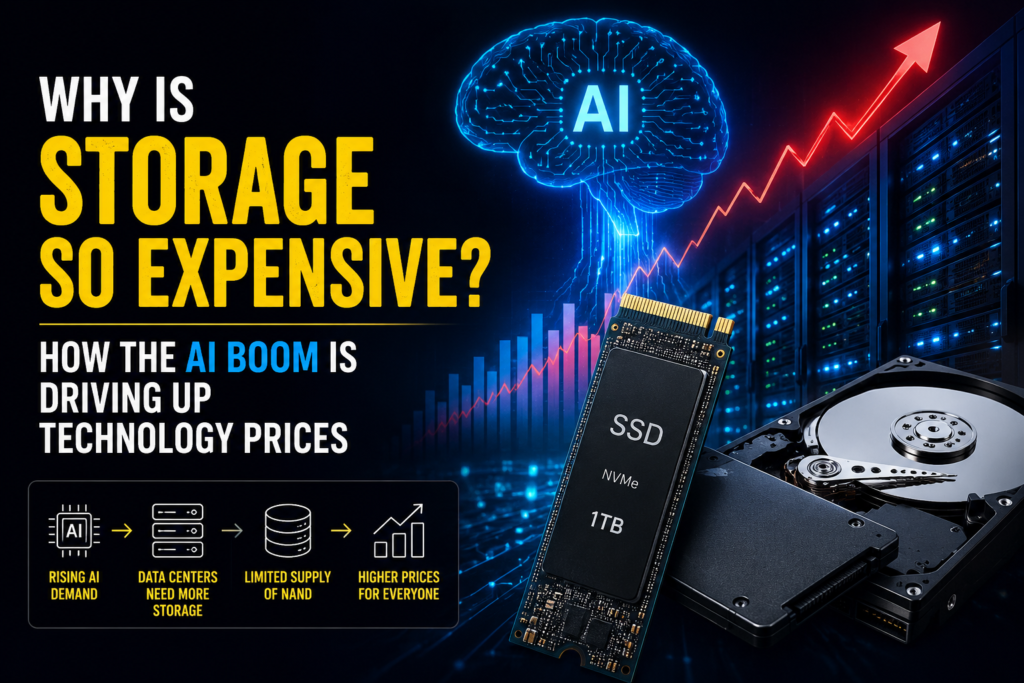
For years, storage became one of the cheapest parts of buying a smartphone, laptop, camera, or gaming device. A few years ago, upgrading from 256GB to 512GB or 1TB often felt relatively inexpensive. Now, that equation is changing. The surprising reason? Artificial intelligence. The rapid expansion of AI is creating enormous demand for data-center storage, while manufacturers are struggling to expand supply quickly enough. The result is a tighter NAND flash market—and higher costs that can eventually reach consumers. TrendForce estimates that the NAND Flash market will remain undersupplied through 2026, with a projected 4–5% supply deficit. The AI Boom Is Creating a Storage Boom Every AI model needs data. Training data, model checkpoints, databases, user information, cached information and the enormous amount of data generated during AI inference all have to be stored somewhere. And this isn’t happening on a few computers. Major cloud providers and technology companies are building enormous AI data centers filled with servers and high-capacity storage. According to TrendForce, servers now account for more than 40% of total NAND Flash bit demand, showing just how dramatically the storage market is shifting toward data centers. The demand isn’t simply for more storage—it is for fast, high-performance storage capable of handling huge amounts of data quickly. That makes enterprise SSDs particularly important. What Does This Have to Do With Your Laptop? A laptop’s SSD and a data center’s SSD are built for different workloads, but they depend on the same fundamental NAND Flash technology. And here’s where the supply problem begins. Memory manufacturers have limited production capacity. When demand from AI infrastructure and enterprise customers rises rapidly, manufacturers have an incentive to prioritize higher-value products. TrendForce has reported that supplier capacity has been increasingly crowded toward enterprise and AI-related demand, creating pressure on consumer-grade SSD supply. So while you’re looking at a laptop with a 1TB SSD, somewhere else a data center may be buying thousands of high-capacity enterprise SSDs. When millions of dollars are being spent on storage infrastructure, manufacturers naturally have to balance where their limited production capacity generates the greatest return. The Economics Are Simple: More Demand + Limited Supply = Higher Prices Think of it like this: AI data centers ↑ → Storage demand ↑ → NAND demand ↑ → Supply becomes tighter → Component prices ↑ → Device manufacturing costs ↑ → Consumer prices ↑ It’s basic economics, but the scale of the AI boom makes the effect much larger. TrendForce expects NAND Flash contract prices to continue rising in Q3 2026, although the rate of increase is expected to slow as consumer demand weakens under higher costs. It’s Not Just SSDs The broader memory market is also under pressure. AI systems require enormous quantities of DRAM and high-bandwidth memory (HBM) alongside storage. Manufacturers are therefore making difficult decisions about how to allocate production capacity across different types of memory. This is why the current situation isn’t simply an “SSD shortage.” It’s becoming a memory supply challenge across the technology industry. IDC has also highlighted how rising DRAM and NAND costs are reshaping smartphone and PC markets in 2026, potentially affecting both pricing and device specifications. Why Are Consumers Feeling It Now? Technology companies don’t immediately pass every component-price increase to customers. They may initially absorb some of the additional cost, reduce discounts, change specifications, or negotiate longer-term supply contracts. But when component prices remain elevated, eventually manufacturers have fewer options. That can result in: And the impact can be particularly noticeable in products where storage capacity is a major selling point. Could Prices Come Back Down? Possibly—but probably not immediately. The encouraging news is that manufacturers are expanding production and upgrading existing manufacturing processes. TrendForce expects NAND supply growth to eventually outpace demand in 2027, with supply constraints potentially easing during the second half of 2027. However, AI infrastructure is continuing to expand, so the industry has to keep increasing supply simply to keep up with demand. That means the old era of extremely cheap storage may not return quickly. The Bigger Picture The storage-price story is really a story about how AI is changing the economics of technology. We usually think about AI in terms of chatbots, image generation, autonomous systems and intelligent software. But behind all of that is an enormous physical infrastructure consisting of chips, servers, networking equipment, electricity—and increasingly, storage. The AI revolution isn’t happening only on our screens. It’s happening inside data centers, semiconductor factories and supply chains around the world. And when those systems consume more of the world’s memory and storage capacity, consumers can eventually feel the impact when they buy something as ordinary as a laptop, smartphone, SSD or memory card. Final Thought The next time you see the price of a laptop or SSD climbing, it may not simply be because the company decided to charge more. Behind that price could be a much bigger story: the world’s rapidly growing appetite for AI. Sources: TrendForce, IDC and recent industry reporting.
From AI Data Centers to Your Laptop: The Rising Cost of Storage Read More »